The Balance Challenge!
Before You Read The Full Balance Habit List...
If You’ve Started Walking A Little Closer To The Wall… This Is The Story I Wish Someone Had Told Me First.
Maybe you’ve caught yourself doing it lately.
Keeping one hand near the counter. Taking the railing before your foot finds the first step. Slowing down when the floor changes. Pausing — just for a second — before you turn around.
And telling yourself the same thing my mother told me:
“I’m just being careful.”
If that sounds familiar, then this story is about you as much as it’s about her. Because last year, on my birthday, my 81-year-old mom said those exact words to me one week — and fell the next.
And the hardest part wasn’t the fall. It was that I’m a personal trainer… and I looked right at the warning signs and called them nothing.
Here’s What I Didn’t Understand Until It Was Too Late.
My mom didn’t lose her balance all at once.
She lost it the way almost everyone does — one cautious step at a time, over months, while everyone around her (including me) called it “getting older.”
The hand on the wall. The smaller steps. The easier path, chosen quietly and never explained. Each one looked like nothing on its own. Together, they were a countdown.
And when you’re the one living it, it doesn’t feel like decline. It feels reasonable. Sensible. Careful.
That’s exactly what makes it so dangerous.
Because the goal was never just to stop a fall. It was to keep you trusting yourself to move through your own home — without fear walking beside you.
And If You’re Reading This, You Already Know The Feeling.
I’ve now heard it from hundreds of people who could be you:
“I’m scared of falling — but I refuse to use a cane.”
“I want to stay independent, but I’m terrified of overdoing it and making things worse.”
“My husband and I both walk near the walls now. Just in case.”
And the one that sounds most like my mom — and maybe a little like you:
“I don’t want to become a burden to my kids.”
You’re not imagining it, and you’re not being dramatic. You’re noticing something real, early — which is the one advantage my mom didn’t have.
After She Fell, I Tried To Fix It The Way Every Trainer Would.
I looked at her legs.
That’s what everyone does. We assume balance is just leg strength. So the advice is always some version of:
- walk more
- strengthen your legs
- do some chair exercises
- practice standing on one foot
- try harder balance drills
And I watched it fail her.
She did the leg work and still felt wobbly. She walked daily and still reached for the counter. She was active — and still froze for half a second before stepping off a curb.
I was missing something, and it was costing her the one thing she wanted most: to feel safe in her own body again.
So I Went Hunting For The Answer I Should Have Had Before Her Birthday.
I dug into everything — balance training, senior fitness, fall-prevention research, ankle stability, hip control, gait patterns, nervous-system training, physical-therapy progressions.
I spent just over $4,200 on courses, books, and certifications. I filled 7 notebooks. I tested 63 different drills and progressions — on myself first, then with the older adults I work with.
And I held every single one up against one question:
“Would this have helped my mom — before the fall?”
Almost every time, the honest answer was no. The advice was too vague, too advanced, or too random. None of it was built for the person who walks near the wall “just in case” — the person who wants to stay independent but is scared of pushing too hard.
In other words: none of it was built for someone like her. Or someone like you.
Then One 10-Second Test Showed Me What I’d Been Missing.
I stopped asking “Which exercise should she do?” and started asking something better — the question this whole story turns on:
“Can her body still trust one leg at a time?”
One simple single-leg check answered it. Not fancy. No equipment. But it exposes the real problem in about ten seconds — and you can do it right now, where you’re sitting.
The 10-Second Single-Leg Balance Check
- Stand next to a counter, wall, or sturdy chair.
- Keep one hand close to your support.
- Lift one foot about an inch off the floor.
- Try to hold it for 10 seconds.
- Set your foot back down.
- Switch sides and repeat.
Don’t close your eyes. Don’t try to tough it out. Stop immediately if anything feels unsafe.
Here’s what the test looks like in real life — hand near support, one foot lifted, holding steady.
If you couldn’t comfortably hold 10 seconds on both sides — please don’t brush it off the way I let my mom brush it off.
That’s not “just getting older.” That’s your body handing you a warning — while you still have time to answer it.
And That’s When It Finally Hit Me.
Everyone thinks the single-leg test measures leg strength. It doesn’t.
The moment you lift one foot, your entire balance system gets put on the spot at once. Your foot has to feel the floor. Your ankle has to fire tiny corrections. Your hip has to stop you drifting. Your standing leg has to hold. And your brain has to believe it’s safe enough to stay there — without lunging for something to grab.
That was the realization I’d spent $4,200 and 7 notebooks chasing:
My mom’s problem was never her legs. It was that her body had quietly stopped trusting them — and trust can be rebuilt, but only in the right order.
The wobble, the stiffening, the grab for the counter, the held breath — those aren’t weak legs. They’re a broken chain. And a chain can be repaired, one link at a time.
Why This Matters So Much After 60
Balance trouble rarely takes over all at once. It creeps in through tiny adjustments — the same ones you might already be making.
A little closer to the wall. A hand near the counter. A firmer grip on the railing. Avoiding uneven ground. Smaller steps, because your body just doesn’t feel as trustworthy as it used to.
One quiet adjustment at a time, those become your new normal. And you stop asking “Can I get this back?” and start saying “I just need to be careful” — the exact words my mom used.
But you don’t want your world to keep shrinking. You don’t want to depend on walls and railings to cross your own home. And you don’t want to become a burden to the kids you spent your life taking care of.
Balance loss doesn’t just steal your movement. It steals your confidence first — and that’s the part you can start protecting today, while you still have the head start she didn’t.
So I Put The System Into One Simple Guide
The 3-Day Rapid Steady Balance Blueprint
This is the guided, do-it-with-me version of everything you just read.
Instead of guessing which balance habit to try first, you follow one clear focus each day — using beginner-friendly movements designed for adults who want to feel steadier, safer, and more confident in everyday movement.
You don’t need to be fit to start. You don’t need a gym. You don’t need a single advanced drill. You just need the right starting point, support nearby, and a clear order to follow.
Day 1: Wake Up Your Ankle Stabilizers
Simple seated and supported movements to reconnect your feet and ankles to steadier, more responsive movement.
Day 2: Rebuild Hip And Leg Support
Beginner-friendly movements that support standing, turning, stepping, and walking with more control underneath you.
Day 3: Practice Steady Movement Safely
Chair-, wall-, or counter-supported drills that let your body rehearse moving with real confidence — safely.
This isn’t another random balance list. It’s the exact starting order I wish my mom had — before a fall forced the issue. You get to start before that. She didn’t.
And Yes — The Small Balance Habits Are Included Too.
These habits work because they fit the life you already live. You can practice steadiness while you make your coffee, brush your teeth, stand at the counter, watch TV, or walk the hallway with support close by.
But the real key was never a bigger list. It’s knowing where to start, what to do first, and how to practice it safely.
Inside, You Also Get The Complete 100-Habit Balance Guide.
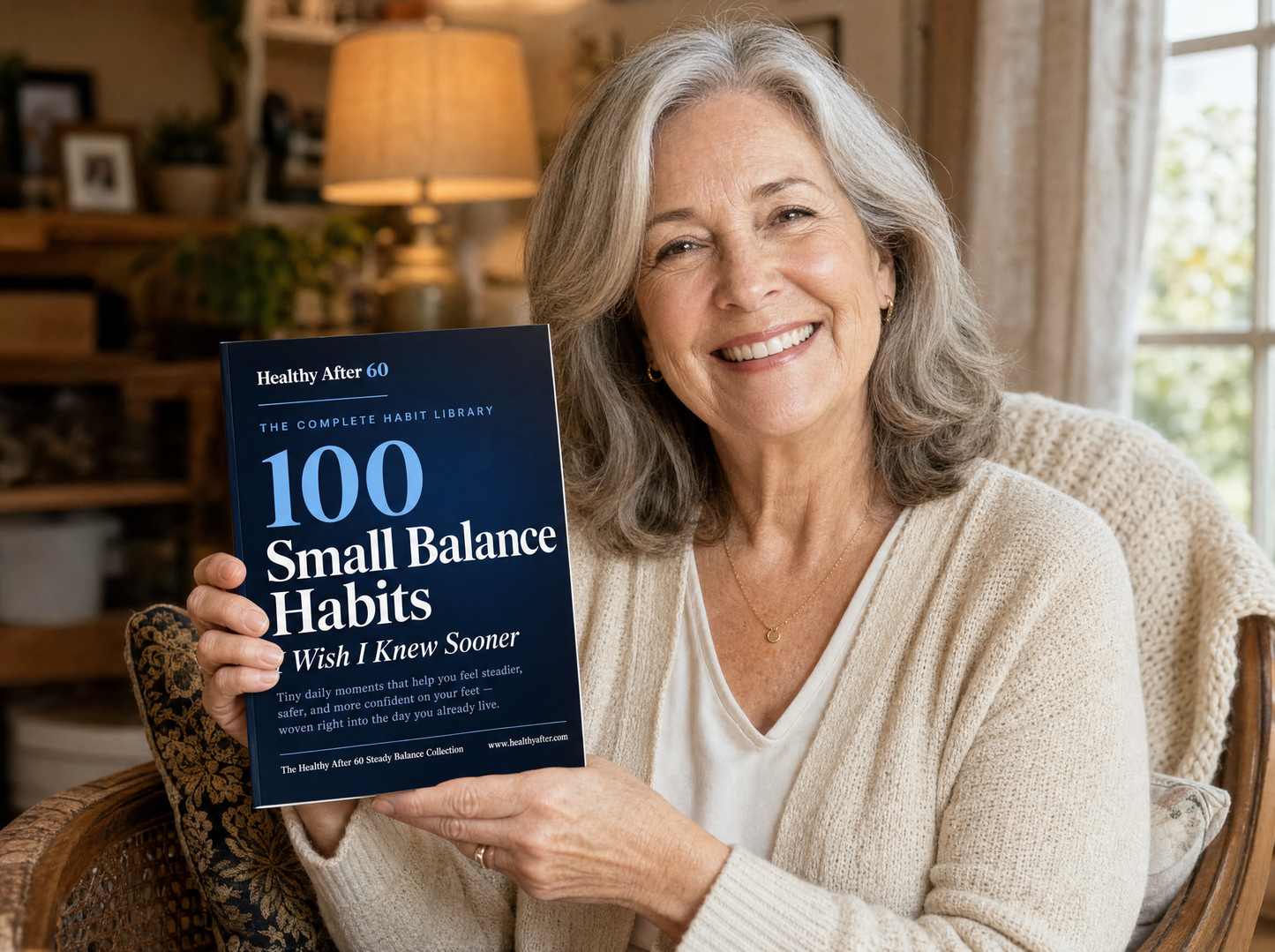
The Facebook post showed you just a few of the small balance habits. But inside the 3-Day Rapid Steady Balance Blueprint, you also get the full bonus guide: 100 Small Balance Habits I Wish I’d Known Sooner.
It’s organized by the everyday moments you already move through — making coffee, brushing your teeth, standing from a chair, walking down the hallway, turning in the kitchen, stepping through doorways, and moving around your home with more confidence than you’ve felt in years.

3 Day Rapid Steady Balance Blueprint Complete Bundle
3 Day Rapid Steady Balance Blueprint Complete Bundle
Your 5-Piece Better Balance Bundle
One clear starting plan, one repeatable daily routine, and three practical companion guides.

Real Results From Real Members
1 in 4 adults over 65 falls each year. Be different. Stay steady.
4.6 out of 5 · 4,371 verified reviews · 23,000+ members

Got my confidence back!
I'd started holding the rail with both hands and taking the stairs one at a time. After the first week I wasn't reaching for the wall in the hallway anymore. Such a simple thing, but it gave me my confidence back.
Barbara L. · Age 68 · ✓ Verified

Finally felt safe to start
It starts you off slow, with a chair right there. I was scared of "balance exercises" because I thought they'd make me fall. This one actually felt safe from day one.
Raymond M. · Age 74 · ✓ Verified

My daughter noticed first
My daughter bought this for me after I had a little stumble in the kitchen. I did the 10-second check and couldn't hold it on my left side — that woke me up. Three weeks in and I can do it on both now.
Joan T. · Age 71 · ✓ Verified

The order is what works
I almost didn't buy it because I've wasted money on programs before. The difference here is the order it puts things in — ankles first. That part made sense and it's the only thing that's stuck.
David K. · Age 66 · ✓ Verified
I live alone and my biggest fear is becoming a burden to my kids. Feeling steadier on my feet again has done more for my peace of mind than I can explain. I feel like myself again.
Why This Happens
The Science Behind Unsteady Balance
Balance doesn't fade because your legs get weak. It fades when the small stabilizer muscles around your ankles stop firing the tiny corrections that catch every wobble — and your brain quietly stops trusting your legs. That's exactly what the 3-day order retrains.
The Shift Most Members Notice
From "Just Being Careful" To Feeling Steady Again
- Reaching for the wall "just in case"
- Gripping the railing before the first step
- Pausing before turning or stepping off curbs
- Quietly choosing the easier path
- Worrying about being a burden
- Moving through the house with hands free
- Stepping with more control and less hesitation
- Turning and changing direction with confidence
- Walking the way you actually want to
- Feeling like yourself again
One Last Thing, From Me To You
My mom didn't get a head start. By the time any of us took the warning signs seriously, she'd already fallen.
You're reading this before that happens — which means you still get the one thing she didn't: the chance to rebuild trust in your body while it's still a choice, not a recovery.
That's the whole reason I put this together. Start with Day 1. Keep a hand near the counter. And give your body a reason to trust your legs again.
GET THE BLUEPRINT — $27One-time payment · Instant access · 7-Day Simple Start Guarantee
See It In Action
A Real Book You Can Hold, Read, And Check Off
Big, easy-to-read print. One clear focus per page. No squinting at a screen and no scrolling back to find your place — just turn the page and follow along.
Turn the page, do the dayOne clear focus per page, in big readable print.
Fits into your morningMembers keep it out and work through one page with their coffee.
What's Inside
Three Days. One Clear Focus Per Day.
No guesswork and no random tips — just the right order for rebuilding steadiness, one simple day at a time.
Wake Up Your Ankle Stabilizers
Your first line of defense. Gentle drills that switch on the small muscles that catch every wobble before it grows.
Rebuild Hip & Leg Support
Beginner-friendly movements that support standing, turning, stepping, and walking with more control underneath you.
Practice Steady Movement Safely
Chair-, wall-, and counter-supported drills that let your body rehearse real-life movement with real confidence.
2 At-Home Balance ChecksSpot exactly where your steadiness needs attention in 10 seconds.
Chair & Wall-Supported OptionsEvery movement has a supported version — nothing feels risky.
Clear Daily InstructionsKnow exactly what to do on Day 1, 2, and 3. Nothing to piece together.
"Feel Wobbly?" Safety NotesSimple reminders to slow down and use support when you need it.
Daily Practice TrackerStay consistent without overthinking it — print it and check it off.
No Gym. No Equipment.A sturdy chair, a wall, and a few minutes at home is all it takes.
Free Bonus Book Included
100 Small Balance Habits I Wish I Knew Sooner
A full menu of tiny, beginner-friendly habits you can practice during moments you already live every day — no extra time required. Organized by situation:
The 7-Day Simple Start Guarantee
Try the blueprint for a full 7 days. If it doesn't give you a clear, simple, beginner-friendly way to start practicing steadier movement at home, contact us and we'll refund your purchase. No forms, no hassle.
This product is for educational purposes only and is not intended to diagnose, treat, cure, or prevent any disease or medical condition. Always consult your physician or qualified healthcare provider before beginning any new movement or exercise program, especially if you have balance concerns, dizziness, pain, a history of falls, or any medical condition.
Everything Else You Might Be Wondering
Frequently Asked Questions
How do I get the Blueprint after I order?
Everything is delivered instantly as downloadable PDFs to your email after checkout — the Blueprint, the bonus 100 Small Balance Habits book, and the tracker. You can start reading in the next five minutes. Read on your phone, tablet, or computer, or print at home.
I've never done balance exercises before — and honestly, I'm afraid of falling.
That is exactly who this was built for. Every movement has a chair, wall, or counter-supported option, and Day 1 starts with the simplest exercises in the whole system, so you begin with support nearby instead of jumping into anything advanced.
Do I need any equipment or a gym?
No. You only need a safe space and a sturdy chair, wall, or counter nearby for support. No machines, no floor work if your knees don't love it.
Is this hard exercise? How long until I notice a difference?
It's designed to feel simple and doable, not exhausting. Most members tell us they feel more confident on stairs and uneven ground within the first week, and the plan is made to be repeated as often as you like.
Will this cure balance problems?
No. This is not a medical treatment and does not claim to cure balance problems. It is an educational at-home guide for practicing beginner-friendly movements that support steadier everyday movement. If you have dizziness, vertigo, recent falls, severe pain, recent surgery, a neurological condition, or any medical concern that affects movement, speak with a qualified healthcare professional before starting.
Is this a subscription? Will I be charged again?
No. This is a one-time purchase. You are not enrolled in any recurring plan and will never be charged again unless you choose to buy something else.
What if it doesn't work for me?
You're covered by the 7-Day Simple Start Guarantee. If it doesn't give you a clear, simple way to start practicing steadier movement at home, email us within 7 days and we'll refund you in full — no questions asked.