The Balance Challenge
The moment that changed everything
My 81-year-old mom fell on my birthday.
That was three years ago. I still remember the phone call—and the guilt that came right after it.
I was a personal trainer. I thought I understood movement. Yet I had watched her begin walking closer to the wall, pausing before turns, and keeping one hand near the counter—and I accepted the same explanation she did: “I’m just being careful.”
After the fall, those small changes no longer looked harmless. They looked like warnings I should have understood sooner.
I didn’t want her world to keep getting smaller because she was afraid of the next step.
Why my training background was not enough
I spent thousands of hours—and thousands of dollars—trying to understand what I had missed.
I studied balance training, ankle stability, hip control, gait, fall-prevention education, and beginner-friendly progressions. I kept asking one question: What could my mom actually repeat safely, without a gym or an overwhelming exercise library?
The answer was not a harder workout. It was a better starting point and a simple sequence she could practice consistently.
A useful starting signal—free
The simple 10-second balance check
Clinicians can use structured balance screening as part of a professional evaluation. I want to show you the basic idea here for free, so you can recognize a possible warning sign instead of ignoring it.
Why this test? The CDC’s clinician-facing STEADI 4-Stage Balance Test includes a 10-second one-leg stance as its most challenging position. See the CDC test.
- Stand beside a sturdy counter with your eyes open and support within easy reach.
- If you already feel unsteady standing normally, do not attempt the test on your own.
- If it feels safe, hover one hand just above the counter and lift one foot about an inch.
- Try to hold the position for up to 10 seconds. Do not close your eyes or push through fear.
- Stop immediately if you feel unsafe, then repeat on the other side only if appropriate.
If you need to grab the counter, put your foot down early, or wobble strongly, treat that as information—not a diagnosis. It may be worth discussing your balance and fall risk with a qualified healthcare professional.
Safety first: This demonstration is educational and does not replace medical advice, diagnosis, physical therapy, or an individualized fall-risk assessment. Do not perform it alone if you have fallen recently, feel dizzy, use a mobility aid, or are unsure that you can stop safely.
The discovery that changed our approach
The three-step system that helped my mom practice moving with less fear
We stopped chasing random exercises. We used the same three-part order each time, with support nearby and difficulty adjusted to her ability.
Wake Up Foot and Ankle Responses
Begin with gentle, supported movement that helps the feet and ankles respond to small shifts.
Build Hip and Leg Support
Add simple strength and control for the muscles involved in standing, stepping, and turning.
Practice Confident Movement
Repeat safe, everyday patterns so movement feels more familiar and less intimidating over time.
The complete routine is below
I built the 15-minute routine into the 3-Day Rapid Steady Balance Blueprint.
The blueprint gives you one repeatable daily structure instead of another long list of disconnected tips. You can choose the supported starting option that fits your ability and follow the three-step sequence in order.
- A clear 15-minute daily structure
- Supported options for safer practice
- Large, readable instructions
- Three guides that work together as one complete system
Keep scrolling to see the complete system, everything included, and the available formats.

3 Day Rapid Steady Balance Blueprint Complete Bundle
3 Day Rapid Steady Balance Blueprint Complete Bundle
Your 5-Piece Better Balance Bundle
One clear starting plan, one repeatable daily routine, and three practical companion guides.

Real Results From Real Members
1 in 4 adults over 65 falls each year. Be different. Stay steady.
4.6 out of 5 · 4,371 verified reviews · 23,000+ members

Got my confidence back!
I'd started holding the rail with both hands and taking the stairs one at a time. After the first week I wasn't reaching for the wall in the hallway anymore. Such a simple thing, but it gave me my confidence back.
Barbara L. · Age 68 · ✓ Verified

Finally felt safe to start
It starts you off slow, with a chair right there. I was scared of "balance exercises" because I thought they'd make me fall. This one actually felt safe from day one.
Raymond M. · Age 74 · ✓ Verified

My daughter noticed first
My daughter bought this for me after I had a little stumble in the kitchen. I did the 10-second check and couldn't hold it on my left side — that woke me up. Three weeks in and I can do it on both now.
Joan T. · Age 71 · ✓ Verified

The order is what works
I almost didn't buy it because I've wasted money on programs before. The difference here is the order it puts things in — ankles first. That part made sense and it's the only thing that's stuck.
David K. · Age 66 · ✓ Verified
I live alone and my biggest fear is becoming a burden to my kids. Feeling steadier on my feet again has done more for my peace of mind than I can explain. I feel like myself again.
Why This Happens
The Science Behind Unsteady Balance
Balance doesn't fade because your legs get weak. It fades when the small stabilizer muscles around your ankles stop firing the tiny corrections that catch every wobble — and your brain quietly stops trusting your legs. That's exactly what the 3-day order retrains.
The Shift Most Members Notice
From "Just Being Careful" To Feeling Steady Again
- Reaching for the wall "just in case"
- Gripping the railing before the first step
- Pausing before turning or stepping off curbs
- Quietly choosing the easier path
- Worrying about being a burden
- Moving through the house with hands free
- Stepping with more control and less hesitation
- Turning and changing direction with confidence
- Walking the way you actually want to
- Feeling like yourself again
One Last Thing, From Me To You
My mom didn't get a head start. By the time any of us took the warning signs seriously, she'd already fallen.
You're reading this before that happens — which means you still get the one thing she didn't: the chance to rebuild trust in your body while it's still a choice, not a recovery.
That's the whole reason I put this together. Start with Day 1. Keep a hand near the counter. And give your body a reason to trust your legs again.
GET THE BLUEPRINT — $27One-time payment · Instant access · 7-Day Simple Start Guarantee
See It In Action
A Real Book You Can Hold, Read, And Check Off
Big, easy-to-read print. One clear focus per page. No squinting at a screen and no scrolling back to find your place — just turn the page and follow along.
Turn the page, do the dayOne clear focus per page, in big readable print.
Fits into your morningMembers keep it out and work through one page with their coffee.
What's Inside
Three Days. One Clear Focus Per Day.
No guesswork and no random tips — just the right order for rebuilding steadiness, one simple day at a time.
Wake Up Your Ankle Stabilizers
Your first line of defense. Gentle drills that switch on the small muscles that catch every wobble before it grows.
Rebuild Hip & Leg Support
Beginner-friendly movements that support standing, turning, stepping, and walking with more control underneath you.
Practice Steady Movement Safely
Chair-, wall-, and counter-supported drills that let your body rehearse real-life movement with real confidence.
2 At-Home Balance ChecksSpot exactly where your steadiness needs attention in 10 seconds.
Chair & Wall-Supported OptionsEvery movement has a supported version — nothing feels risky.
Clear Daily InstructionsKnow exactly what to do on Day 1, 2, and 3. Nothing to piece together.
"Feel Wobbly?" Safety NotesSimple reminders to slow down and use support when you need it.
Daily Practice TrackerStay consistent without overthinking it — print it and check it off.
No Gym. No Equipment.A sturdy chair, a wall, and a few minutes at home is all it takes.
Free Bonus Book Included
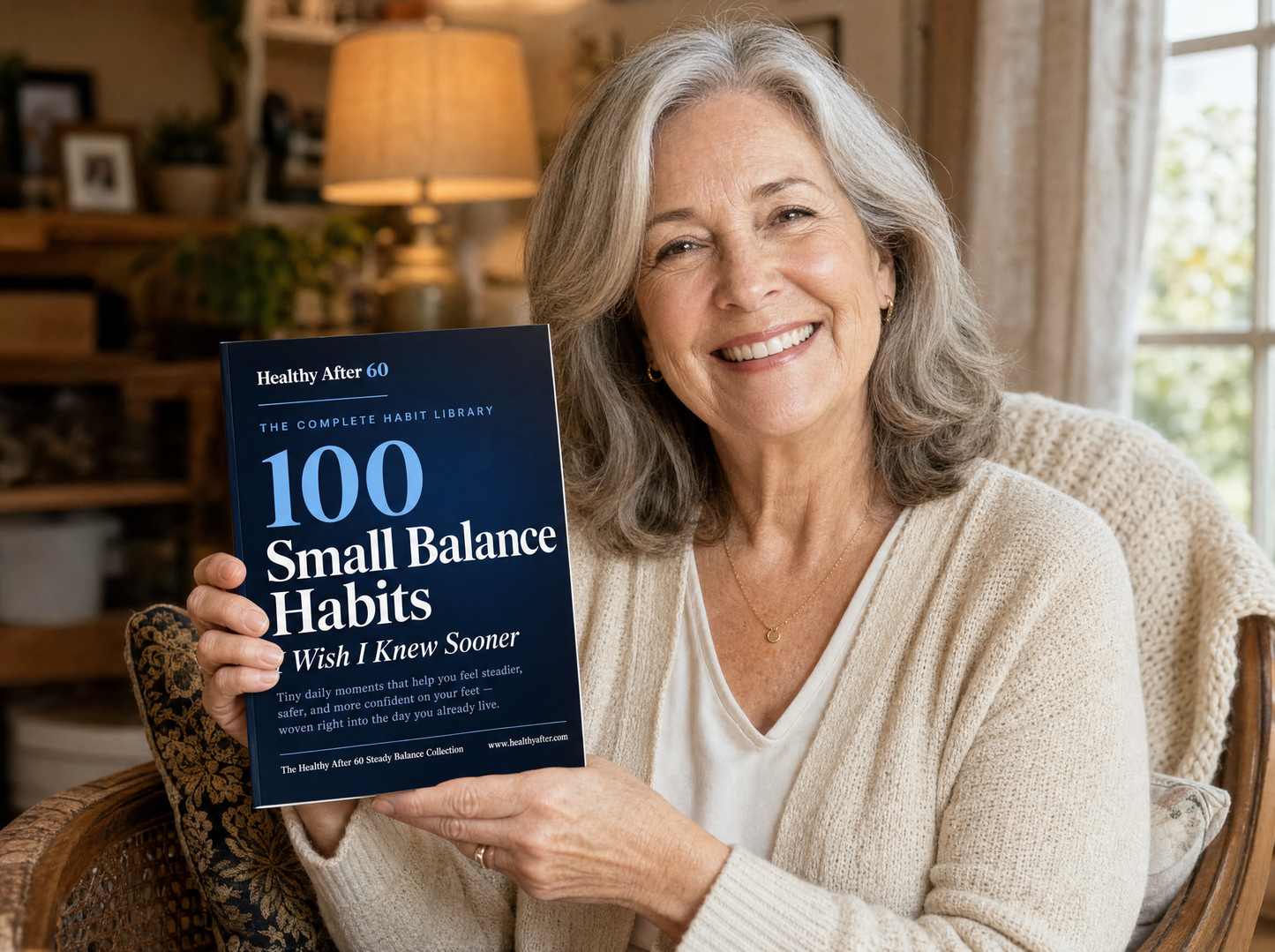
100 Small Balance Habits I Wish I Knew Sooner
A full menu of tiny, beginner-friendly habits you can practice during moments you already live every day — no extra time required. Organized by situation:
The 7-Day Simple Start Guarantee
Try the blueprint for a full 7 days. If it doesn't give you a clear, simple, beginner-friendly way to start practicing steadier movement at home, contact us and we'll refund your purchase. No forms, no hassle.
This product is for educational purposes only and is not intended to diagnose, treat, cure, or prevent any disease or medical condition. Always consult your physician or qualified healthcare provider before beginning any new movement or exercise program, especially if you have balance concerns, dizziness, pain, a history of falls, or any medical condition.
Everything Else You Might Be Wondering
Frequently Asked Questions
How do I get the Blueprint after I order?
Everything is delivered instantly as downloadable PDFs to your email after checkout — the Blueprint, the bonus 100 Small Balance Habits book, and the tracker. You can start reading in the next five minutes. Read on your phone, tablet, or computer, or print at home.
I've never done balance exercises before — and honestly, I'm afraid of falling.
That is exactly who this was built for. Every movement has a chair, wall, or counter-supported option, and Day 1 starts with the simplest exercises in the whole system, so you begin with support nearby instead of jumping into anything advanced.
Do I need any equipment or a gym?
No. You only need a safe space and a sturdy chair, wall, or counter nearby for support. No machines, no floor work if your knees don't love it.
Is this hard exercise? How long until I notice a difference?
It's designed to feel simple and doable, not exhausting. Most members tell us they feel more confident on stairs and uneven ground within the first week, and the plan is made to be repeated as often as you like.
Will this cure balance problems?
No. This is not a medical treatment and does not claim to cure balance problems. It is an educational at-home guide for practicing beginner-friendly movements that support steadier everyday movement. If you have dizziness, vertigo, recent falls, severe pain, recent surgery, a neurological condition, or any medical concern that affects movement, speak with a qualified healthcare professional before starting.
Is this a subscription? Will I be charged again?
No. This is a one-time purchase. You are not enrolled in any recurring plan and will never be charged again unless you choose to buy something else.
What if it doesn't work for me?
You're covered by the 7-Day Simple Start Guarantee. If it doesn't give you a clear, simple way to start practicing steadier movement at home, email us within 7 days and we'll refund you in full — no questions asked.