Pro Health Tip

Roll your shoulder BACK in slow circles for 30 seconds. (Most people roll forward which makes posture worse).

15 Everyday Habits Making Your Shoulder Pain Worse After 60

15 Everyday Habits Making Your Shoulder Pain Worse After 60

15 Everyday Habits Making Your Shoulder Pain Worse After 60

If reaching for a coffee mug, pulling on a sweater, or finding a comfortable sleeping position has become a daily battle, these common habits may be the hidden reason. Here are 15 everyday things quietly making your shoulder stiffness and rotator cuff pain worse.

1. Sleeping on your painful shoulder every night

The moment you wake up with that deep ache and can barely lift your arm to turn off the alarm, you feel old and helpless. The hidden cause is constant pressure on the rotator cuff all night. Simple advice: Switch to your back with a pillow under each arm or try sleeping in a recliner for a few nights.

2. Reaching overhead with a sudden jerk

You go to grab something from the top cupboard and feel that sharp pull. It makes you feel weak and limited. The hidden cause is years of poor shoulder mechanics finally catching up. Simple advice: Step on a sturdy stool and bring the item down at eye level instead of stretching.

3. Carrying heavy bags on one shoulder

Every time you load up your purse or grocery bag, you feel lopsided and drained. The hidden cause is constant imbalance stressing one rotator cuff. Simple advice: Switch sides frequently or use a backpack with both straps.

4. Slouching while watching television

After an evening on the couch you can barely lift your arms without stiffness. You feel closed-off and tight in your own body. The hidden cause is rounded shoulders weakening the upper back muscles that support your rotator cuff. Simple advice: Sit with a small pillow behind your lower back and roll your shoulders back every 20 minutes.

5. Brushing or styling hair with the painful arm

Standing in front of the mirror struggling to reach the back of your head leaves you feeling embarrassed. The hidden cause is repetitive overhead motion with poor mobility. Simple advice: Use your other arm or lower your head toward the brush instead of lifting the arm so high.

6. Pulling on clothes overhead aggressively

Getting dressed in the morning becomes a frustrating ordeal that ruins your whole day. The hidden cause is forceful pulling through a stiff shoulder joint. Simple advice: Dress the painful arm first and choose looser tops with front buttons when possible.

7. Leaning on your elbow while reading or using your phone

You feel the ache travel down your arm and suddenly can’t reach behind you. The hidden cause is compression of the shoulder structures. Simple advice: Keep elbows supported at desk height or use a pillow on your lap.

8. Tightening your seatbelt with the same arm every time

That familiar pull when you reach across your body reminds you how limited you’ve become. The hidden cause is repetitive cross-body strain on the rotator cuff. Simple advice: Use your other hand or turn your torso more.

9. Ignoring early morning stiffness and pushing through

You feel frustrated that simple movements hurt right after waking. The hidden cause is letting inflammation build up without gentle movement. Simple advice: Do 5 slow arm circles and shoulder rolls before getting out of bed.

10. Using only your dominant arm for lifting

When you lift a pot or grandchild you feel that familiar weakness and fear dropping something. The hidden cause is overworking one side while the other gets weaker. Simple advice: Share the load between both arms consciously.

11. Keeping your arms crossed for long periods

You notice poor posture in photos and feel self-conscious about looking hunched. The hidden cause is shortening the chest muscles and weakening the back. Simple advice: Open your arms and roll shoulders back several times a day.

12. Doing housework with arms raised for too long

Hanging curtains or reaching to clean shelves leaves you sore for days. The hidden cause is holding shoulders in stressful positions too long. Simple advice: Take breaks every 2-3 minutes and bring arms down to rest.

13. Using a computer mouse too far away

By evening your shoulder feels worn out from constant reaching. The hidden cause is forward shoulder strain from poor desk setup. Simple advice: Keep the mouse close so your elbow stays near your side.

14. Sleeping with arms above your head

You wake up with numbness and that trapped feeling in your shoulder. The hidden cause is stretching the rotator cuff in vulnerable positions all night. Simple advice: Keep arms down by your sides or on a pillow.

15. Never stretching the back of your shoulders

Reaching behind your back to tuck in a shirt feels impossible and embarrassing. The hidden cause is extremely tight posterior shoulder capsule from years of neglect. Simple advice: Gently bring one arm across your chest and hold for 20 seconds twice a day.

Which of these habits surprised you most? Many people over 60 can dramatically reduce shoulder pain by changing just 2 or 3 of these daily patterns. The full list with more details is on our blog.

Many people assume this is simply part of getting older. But often, the real issue is the shoulders slowly pulling everything forward over time. That’s why so many people begin looking older, weaker, and more tired than they actually feel.

Pro Health Tip

Place your phone at eye level for 2 minutes.

👉 You’ll feel how much your neck normally collapses.

As Seen On

As Seen On

As Seen On

As Seen On

As Seen On

As Seen On

As Seen On

As Seen On

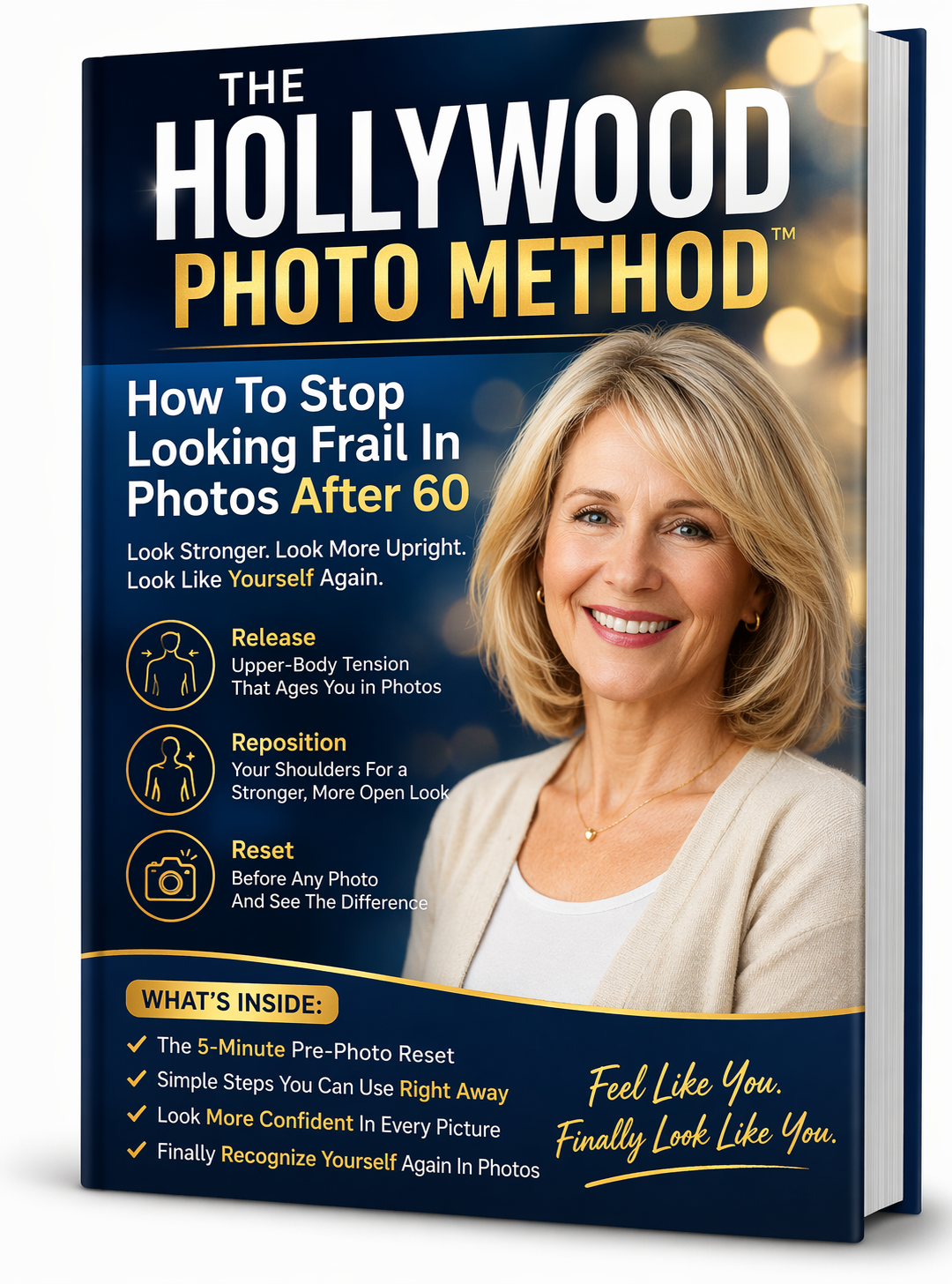
“How To Stop Looking Frail In Photos After 60”

The simple Hollywood Photo Method™ that helps you look stronger, more upright, and more like yourself again

If you’ve ever looked at a photo of yourself and thought,

“I don’t feel this old… so why do I look like that?”

It’s a strange feeling.

You still feel like yourself.

You’re still living your life. You’re still doing normal things. You don’t walk around thinking of yourself as frail.

And then someone takes a picture.

Suddenly you look smaller. More tired. More worn down. Maybe even weaker than you feel inside.

Most women assume that means it’s just age.

So they do what most people do. They blame the angle. They blame the camera. They blame the lighting. They try smiling differently. Standing differently. Dressing differently.

But the photos still don’t look right.

What most women don’t realize is that the “frail look” often doesn’t start with their face at all.

It usually starts higher up in the body.

Tiny changes in the way the shoulders sit. Tension in the upper body. The chest closing in a little. The neck shortening. The whole frame subtly collapsing inward over time.

In real life, movement softens a lot of that.

But a photo freezes it.

And the camera can make those small shifts look much bigger than they really are.

That’s why you can feel completely normal in the mirror… and then look at a candid photo and wonder who that woman is.

Why most women never fix it

Because they’re trying to solve it from the outside in.

They focus on makeup. Clothes. Weight. Better camera angles. Better expressions.

But they never address the subtle upper-body positioning that is quietly changing how they show up in pictures.

That’s the reason I put together the Hollywood Photo Method™.

Not to make women look fake. Not to make them pose like someone they’re not. And not to chase some impossible “look younger overnight” fantasy.

The point of this method is much simpler than that.

It helps you stop looking weaker, smaller, and more worn down than you really are.

It shows you how to reset the parts of your body that most strongly affect how you read on camera — so you look more open, more balanced, and more like yourself again.

What the method helps you do

  • Understand why photos can make you look frailer than you really are
  • Recognize the upper-body tension patterns that change how you appear on camera
  • Reset your shoulders and upper frame before a photo is taken
  • Look more upright and open without stiff “good posture” forcing
  • Stop looking so tired, collapsed, or closed off in candid pictures
  • Feel more confident the next time someone pulls out a camera

This isn’t about pretending to be someone else.

It’s about no longer feeling surprised or disappointed every time you see yourself in a photo.

It’s about finally seeing a version of yourself that actually matches how you still feel inside.

I didn’t figure this out right away

I went through the same cycle most people do.

I thought it was just bad photos at first.

Then I thought maybe it was lighting. Or angles. Or maybe I just needed to “try harder” to look better.

I even caught myself standing differently before pictures… forcing my posture… holding my breath… trying to “fix it” in the moment.

And somehow that made it worse.

Because it didn’t feel natural. And it didn’t actually change what the camera was picking up.

The shift that changed everything

The moment things started to change was when I stopped trying to fix the photo…

…and started fixing what the camera was actually seeing.

That’s the entire idea behind this.

Once you understand what’s really creating that “frail” look…

it becomes surprisingly simple to change it.

Not perfectly. Not dramatically. But enough that you finally stop feeling that disconnect when you see yourself in photos.

Inside the Hollywood Photo Method™, I walk you through:

  • The exact reason your body can look weaker on camera than it feels in real life
  • How subtle shoulder positioning quietly changes your entire appearance
  • The upper-body tension pattern that makes you look more tired than you are
  • A simple reset you can do in under a minute before any photo
  • Why “standing up straight” often backfires (and what works instead)
  • How to look more open and balanced without forcing anything
  • The small shift that helps you look more confident instantly
  • What makes some people naturally photograph better than others
  • How to stop overthinking every picture
  • And how to finally feel comfortable when someone pulls out a camera

This isn’t about trying to look younger.

It’s about not looking weaker, smaller, or more worn down than you actually are.

Why I made this simple

You don’t need a complicated system for this.

You don’t need to spend months fixing posture or learning how to pose like a model.

And you definitely don’t need to avoid photos altogether.

You just need to understand what actually makes the difference — and apply it in a simple, natural way.

Get Instant Access

The Hollywood Photo Method™

$19

Instant access. Simple to follow. No complicated steps.

If it doesn’t help you feel more confident seeing yourself in photos, you don’t have to keep it.

At the end of the day, this isn’t really about photos.

It’s about that moment when you see yourself and think,

“That actually looks like me.”

And not feeling like you have to hide from the camera anymore.